 Culino Kitchen
As food processors prepare for 2026, machinery design is becoming more demanding. Production lines must handle moisture, heat, acids, cleaning chemicals, and constant daily use. This is why many manufacturers continue asking why stainless steel is preferred in food machinery. The answer involves hygiene, strength, maintenance, and long-term reliability.
In real processing environments, stainless steel surfaces are easier to inspect and clean. Smooth welds leave fewer places for food residue to collect. A stainless steel conveyor may face water spray, vegetable acids, salt, and repeated sanitation cycles each day. Properly selected grades can resist corrosion and maintain structural stability under these conditions. They also support practical designs, including sealed frames, sloped surfaces, removable guards, and accessible contact parts. These details matter during busy production shifts.
Still, stainless steel is not automatically perfect. Poor fabrication can create sharp edges, rough welds, or hidden gaps. Incorrect grade selection may also cause staining or premature corrosion. Experience shows that material choice must match the food, temperature, cleaning method, and operating environment. A professional evaluation should include surface finish, weld quality, drainage, inspection access, and replacement costs. Numbers alone can mislead. A cheaper machine may demand more repairs later.
This guide examines the leading food machinery trends for 2026. It explains where stainless steel performs well and where careful engineering remains necessary. Clean design matters. So does honest maintenance planning.
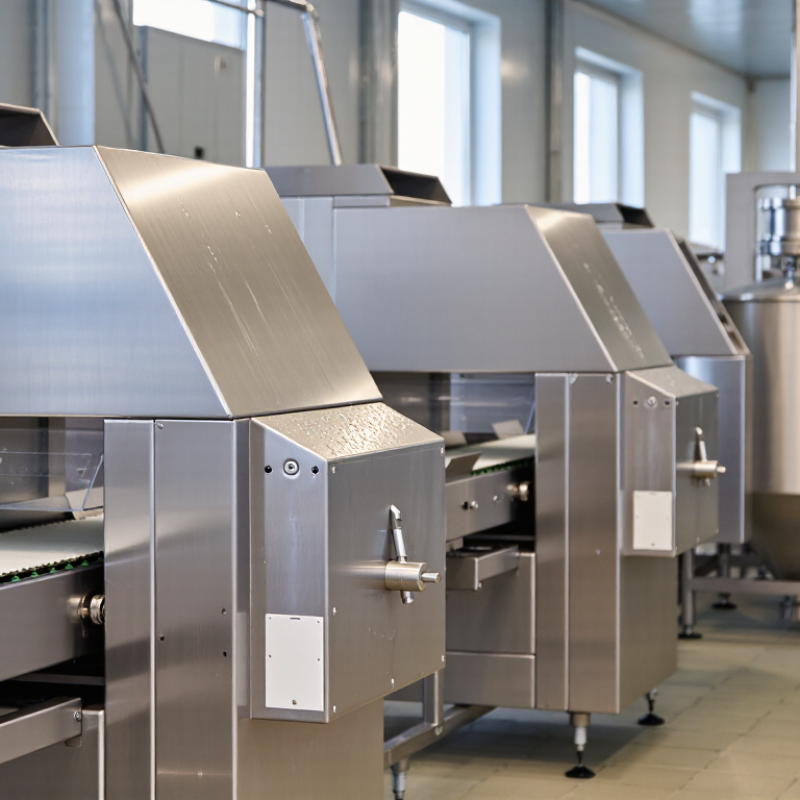
Stainless steel in food machinery is an iron-based alloy containing chromium. Chromium creates a thin protective oxide layer on the surface. This layer helps resist rust and supports hygienic processing.
In food plants, stainless steel meets water, oils, salts, and cleaning chemicals every day. Common grades include 304 and 316. The correct choice depends on moisture, chloride exposure, temperature, and cleaning routines. The grade matters. A wet conveyor handling brine may need more corrosion resistance than a dry flour hopper. Food-contact surfaces are usually smooth, welded carefully, and designed without deep gaps. These details limit residue buildup and make inspection easier.
During practical equipment checks, I pay attention to scratches, rough welds, trapped water, and discolored areas. A bright finish does not automatically mean a safe surface. Poor polishing can leave tiny crevices around joints. Chloride residue can also attack stainless steel when cleaning is incomplete. Stainless steel is durable, but it is not maintenance-free. Operators still need suitable detergents, proper rinsing, and routine visual checks. I have seen clean-looking frames hide residue beneath brackets. That small weakness can affect hygiene and service life. Material selection must therefore follow the machine’s real working conditions, not appearance alone.
Material comparison and hygienic-design data for common stainless steel selections in food-processing equipment
| Data Dimension | 304 Stainless Steel | 316L Stainless Steel | 430 Stainless Steel | Food-Machinery Relevance |
|---|---|---|---|---|
| Material Definition | Austenitic chromium-nickel stainless steel | Austenitic chromium-nickel-molybdenum stainless steel | Ferritic chromium stainless steel | All three grades form a passive chromium-oxide surface layer that helps protect the underlying metal from corrosion. |
| Typical Chemical Composition | Approximately 18% chromium and 8% nickel; maximum carbon commonly 0.08% | Approximately 16–18% chromium, 10–14% nickel, and 2–3% molybdenum; low-carbon version | Approximately 16–18% chromium; normally contains little or no nickel | Exact composition depends on the applicable standard and product form. Mill certificates should be used for final verification. |
| General Corrosion Resistance | Very good in normal food-processing environments | Excellent, especially in chloride-containing or saline environments | Good in mild, low-chloride indoor environments | 316L is generally preferred where brine, salt, acidic food residues, or aggressive cleaning chemicals are present. |
| Resistance to Pitting and Crevice Corrosion | Good, but more vulnerable to chlorides than 316L | Very good because molybdenum improves chloride resistance | Lower than 304 and 316L in chloride-bearing service | Avoid stagnant liquid, sharp crevices, and chloride deposits regardless of grade. |
| Typical Density | Approximately 7.9–8.0 g/cm³ | Approximately 7.9–8.0 g/cm³ | Approximately 7.7–7.8 g/cm³ | Density affects equipment weight, frame loading, transport, and installation requirements. |
| Typical Thermal Conductivity at Room Temperature | Approximately 14–16 W/m·K | Approximately 13–16 W/m·K | Approximately 24–26 W/m·K | Stainless steel has relatively low thermal conductivity compared with carbon steel or aluminum, which can reduce heat transfer through equipment walls. |
| Typical Tensile Strength | Approximately 515 MPa minimum for common annealed sheet specifications | Approximately 485 MPa minimum for common annealed sheet specifications | Approximately 450 MPa minimum for common annealed sheet specifications | Actual strength varies with standard, thickness, cold working, and heat treatment. |
| Typical Yield Strength | Approximately 205 MPa minimum | Approximately 170 MPa minimum | Approximately 205 MPa minimum | Design calculations must use certified material values and the applicable pressure, structural, or machinery standard. |
| Typical Elongation | Approximately 40% minimum | Approximately 40% minimum | Approximately 22% minimum | Higher elongation generally improves forming performance and resistance to cracking during fabrication. |
| Weldability | Excellent with common fusion-welding processes | Excellent; low carbon reduces sensitization risk after welding | Good, but heat-affected-zone behavior requires greater process control | Welds should be properly cleaned, passivated when required, and finished without food-trapping defects. |
| Formability | Excellent; suitable for deep drawing and complex hygienic components | Excellent, with work hardening similar to 304 | Moderate; less suitable for severe deep drawing | Austenitic grades are commonly selected for tanks, hoppers, piping, guards, and formed product-contact parts. |
| Magnetic Behavior | Generally non-magnetic when annealed; may become slightly magnetic after cold working | Generally non-magnetic when annealed; may become slightly magnetic after cold working | Magnetic | Magnetism is not a reliable indicator of food suitability or corrosion resistance. |
| Recommended Contact Use | General food contact, wet processing, bakery, dairy, beverage, and packaging equipment | High-salt, acidic, hygienically demanding, or frequently sanitized applications | Dry or lightly corrosive areas, panels, housings, and non-critical components | The correct grade depends on the food chemistry, cleaning regime, temperature, surface finish, and regulatory requirements. |
| Common Surface-Finish Target | Smooth, uniform finish; roughness selected according to hygiene requirements | Smooth, uniform finish; polished or electropolished surfaces may be used for demanding applications | Smooth finish for easier cleaning where corrosion exposure is limited | Surface roughness, weld quality, drainage, and cleanability are as important as the nominal alloy grade. |
| Hygienic-Design Advantage | Non-porous, cleanable, and resistant to many food residues | Non-porous, highly cleanable, and better suited to aggressive sanitation conditions | Cleanable, but requires more careful environmental selection | Food-contact surfaces should avoid cracks, pits, exposed threads, dead legs, and unsealed overlaps. |
| Temperature Capability | Suitable for a wide range of food-processing temperatures; design limits depend on service conditions | Suitable for a wide range of food-processing temperatures; design limits depend on service conditions | Suitable for moderate-to-high temperatures, subject to oxidation and strength considerations | Thermal cycling, welding, scaling, and chemical exposure must be evaluated together rather than by temperature alone. |
| Primary Reason for Selection | Balanced cost, corrosion resistance, strength, and fabrication performance | Enhanced resistance to chlorides and demanding sanitation chemicals | Lower material cost and magnetic, decorative, or enclosure applications | Stainless steel is preferred in food machinery because it combines cleanability, durability, corrosion resistance, and fabrication flexibility. |
Note: Values are typical reference ranges for commonly supplied annealed products and may vary by specification, thickness, heat treatment, surface condition, and test method. Final material selection should be confirmed against applicable food-contact, hygienic-design, pressure, and machinery requirements.
It is an iron-based alloy containing chromium. Chromium forms a thin protective oxide layer. This layer helps resist rust and supports hygienic processing. It is durable, but not maintenance-free.
Its smooth surface limits hidden moisture, oils, and food particles. It also resists water, steam, and many cleaning agents. Its strength handles vibration, impacts, and repeated production cycles. The material helps, but equipment design still matters.
No. Poor welds, sharp corners, and trapped water can collect residue. A bright surface may still hide tiny crevices. Looks can mislead. Good drainage, careful polishing, and accessible surfaces are also necessary.
Grade 304 suits many ordinary food-processing conditions. It performs well with moisture and routine cleaning. Grade 316 offers stronger resistance to salts, chlorides, and aggressive chemicals. Actual water quality can change the result.
Consider grade 316 for brine, seafood, high humidity, or frequent chloride exposure. It may also suit demanding washdown areas. However, it does not solve every corrosion problem. Testing is wiser than confident guessing.
Check welds, corners, fasteners, drain paths, and supporting parts. Look for rough joints, scratches, discoloration, and trapped water. Review a sample weld before approving the full machine. Small defects grow.
Yes. Concentrated chlorides may cause staining or pitting. Incomplete rinsing can leave harmful residue on the surface. Cleaning routines should match the material and exposure conditions. I may still underestimate local water differences.
Use suitable detergents, rinse thoroughly, and dry wet areas when practical. Inspect beneath brackets, around welds, and near fasteners. Keep maintenance records for recurring defects. Hidden residue is easy to miss.
Stainless steel is a core material in modern food machinery because it combines strength, durability, and reliable hygiene performance. Its smooth, nonporous surface helps prevent food particles, moisture, and microorganisms from collecting, while its resistance to corrosion, heat, and frequent washing supports long-term operation. These qualities explain why stainless steel is preferred in food machinery, especially where equipment must meet strict cleanliness and production requirements.
It is commonly used for processing tanks, conveyors, mixers, filling systems, cutting machines, storage vessels, and other components that contact food. When selecting stainless steel equipment, manufacturers should consider the food’s acidity, salt content, temperature, cleaning chemicals, and mechanical demands. The right grade and finish can improve sanitation, reduce maintenance, extend service life, and help maintain consistent product quality. Ultimately, stainless steel provides a practical balance of food safety, operational reliability, and efficient cleaning for a wide range of food-processing applications.
