Culino Kitchen
Large-scale baking depends on more than oven capacity. It requires repeatable heat, controlled airflow, fast recovery, and predictable production costs. A small temperature variation can change crust color, moisture, and product weight across thousands of units. Small errors multiply. Therefore, how to choose the right ovens for large-scale baking should begin with the product, not the equipment brochure.
Industry data reinforces this decision. The UNEP Food Waste Index Report 2024 estimated 1.05 billion tonnes of food waste in 2022. Inconsistent baking can contribute to avoidable rejects, especially when recipes contain sensitive ingredients. The International Energy Agency also identifies industrial energy efficiency as essential for reducing operating costs and emissions. For bakeries, this makes burner efficiency, insulation, heat recovery, and standby consumption practical selection criteria. A lower purchase price may not remain cheaper after years of daily operation.
Experienced production teams should compare oven performance under real working conditions. Ask for recovery-time data after loading, temperature uniformity maps, maintenance records, and verified energy figures. Check whether technicians can reach fans, burners, sensors, and belts without lengthy shutdowns. Also examine controls, batch traceability, ventilation requirements, and compatibility with existing proofers or cooling conveyors. The right answer is rarely the largest oven. It is the oven that matches throughput, footprint, recipe tolerance, labor skills, and future demand. That sounds simple. It is not always. Supplier claims still require testing with your dough, your loading pattern, and your production schedule. A pilot bake can reveal problems that polished specifications hide.
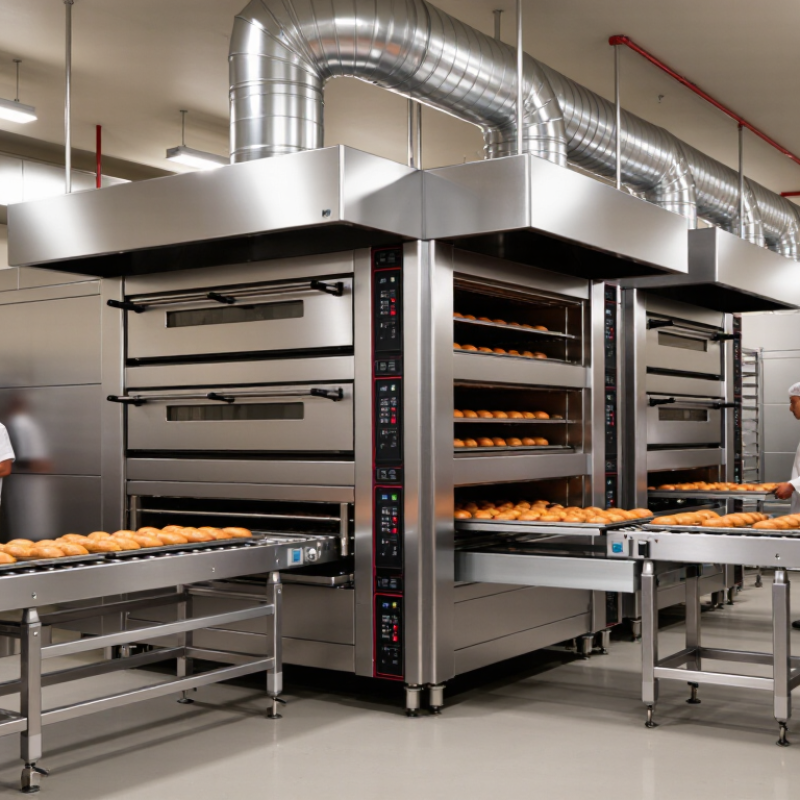
Why Choose the Right Ovens for Large-Scale Baking?
Types of Ovens Used in Large-Scale Baking
Large-scale bakeries commonly use deck, rack, convection, rotary, and tunnel ovens. Each type handles heat differently. Deck ovens deliver strong bottom heat and suit bread, pizza, and crust-focused products. Rack ovens move wheeled trays through controlled airflow. They support flexible batch production and varied recipes.
Convection ovens use fans to distribute heat around trays. This improves consistency for cookies, cakes, and pastries. Rotary rack ovens rotate products during baking. They can reduce uneven browning, although loading patterns still matter. Tunnel ovens support continuous production with separate heating zones. They fit high-volume lines for bread, biscuits, and crackers.
The U.S. Department of Energy’s 2018 Manufacturing Energy Consumption Survey reports that process heating used 51% of manufacturing energy. That figure makes oven efficiency a serious operating issue. The IEA’s Energy Efficiency 2023 report also places industry near 37% of global final energy demand. Heat recovery, insulation, and accurate controls deserve close inspection.
A tunnel oven may appear best on paper. It can fail when product changes are frequent. A rack oven may offer better flexibility, but labor and floor space increase. Plant teams should test real dough weights, tray spacing, moisture levels, and hourly demand. Small temperature errors can become large product losses. Energy data alone is not enough.
Oven selection affects production volume, baking consistency, product flexibility, and energy use. The chart compares representative hourly throughput levels for common oven types used in commercial and industrial baking.
Throughput values are representative industry benchmarks for typical equipment configurations. Actual capacity varies with oven size, product weight, bake time, loading pattern, and operating temperature.
Why Choose the Right Ovens for Large Scale Baking?
Key Factors in Selecting a Commercial Baking Oven
Choosing a commercial baking oven begins with your production goals. Estimate daily output, batch sizes, and peak demand before comparing equipment. A bakery producing delicate pastries needs stable heat and gentle airflow. Bread production may require strong steam control and fast temperature recovery. Rack ovens support flexible batch loading. Deck ovens can provide precise heat from below. The wrong choice creates uneven crusts, longer schedules, and wasted ingredients.
Consider energy use, ventilation, cleaning access, and operator safety. Controls should be clear during busy shifts. Temperature sensors must provide reliable readings, not confusing numbers. Ask about service support, spare parts, and inspection records. These details often matter more than an impressive specification sheet. A practical test bake is valuable. Watch how the oven handles a full load, not just a small sample. Small gaps in performance become expensive at scale.
Tips: Measure your largest trays and door clearance. Check heat recovery after loading. Record baking times for several products. Leave room for maintenance access. Do not ignore noise, lighting, or loading height. One common mistake is choosing maximum capacity too early. Extra space sounds efficient, but unused capacity still consumes energy. Review your assumptions after real production trials. Perfect predictions are rare, and honest adjustments usually improve the final decision.
| Selection Factor | Typical Commercial Range or Requirement | Why It Matters in Large-Scale Baking | Recommended Evaluation Point |
|---|---|---|---|
| Oven Type | Rack, deck, convection, rotary rack, or tunnel | Each design supports different product volumes, loading methods, and baking consistency. | Match the oven configuration to product mix, batch size, and production flow. |
| Production Capacity | Common rack ovens hold approximately 8–32 sheet pans; tunnel ovens are rated by hourly throughput. | Insufficient capacity creates bottlenecks, while excessive capacity increases capital and operating costs. | Calculate peak hourly demand, average load weight, bake time, and required production reserve. |
| Temperature Range | Many commercial baking applications operate around 150–300°C (300–570°F). | The usable range must support the full product portfolio, from delicate pastries to crusty breads. | Confirm maximum temperature, minimum control level, recovery speed, and actual product requirements. |
| Temperature Uniformity | Commercial systems commonly target stable heat distribution with low variation across the baking chamber. | Uniform heat reduces uneven browning, underbaking, product waste, and batch-to-batch variation. | Request heat-mapping or validation data under representative loading conditions. |
| Humidity and Steam Control | Steam injection is common for artisan bread; dry heat is often preferred for cookies and many pastries. | Moisture control influences crust formation, volume, shine, tenderness, and shelf life. | Check steam capacity, exhaust control, drainage, and repeatability of programmed cycles. |
| Heating Energy Source | Electricity or gas; some facilities use a combination of available utility systems. | Energy availability, local prices, ventilation requirements, and emissions considerations affect operating cost. | Compare total energy consumption per batch or per kilogram of finished product. |
| Bake-Time Control | Programmable timers and multi-stage recipes are common in modern commercial ovens. | Precise timing improves consistency and allows operators to manage multiple products efficiently. | Evaluate recipe storage, alarms, automatic cooling, and integration with production procedures. |
| Loading and Unloading | Manual, rack-based, semi-automatic, or continuous conveyor loading. | Efficient material handling reduces labor, product damage, waiting time, and ergonomic risk. | Measure door clearance, rack compatibility, loading time, and floor-space requirements. |
| Energy Efficiency | Insulated chambers, efficient burners or heating elements, and heat recovery can reduce consumption. | Energy is a recurring cost and can significantly affect the total cost of ownership. | Compare measured energy use at the intended temperature, load, and production rate. |
| Cleaning and Sanitation | Smooth food-contact surfaces, removable components, accessible corners, and optional wash systems. | Easy cleaning supports food safety, reduces downtime, and prevents residue from affecting product quality. | Review cleaning time, access points, drainage, approved chemicals, and sanitation records. |
| Footprint and Installation | Requirements vary according to chamber size, service clearances, ventilation, utilities, and access routes. | A suitable oven must fit the facility without disrupting ingredient handling, cooling, or packaging areas. | Verify dimensions, floor loading, electrical or gas connections, exhaust, and commissioning needs. |
| Maintenance and Serviceability | Routine checks may include seals, fans, burners, sensors, filters, steam components, and safety controls. | Shorter maintenance intervals and accessible parts help minimize unplanned production stoppages. | Assess spare-parts availability, preventive-maintenance schedule, diagnostics, and technician response time. |
| Food Safety and Compliance | Equipment should meet applicable electrical, gas, ventilation, occupational-safety, and food-hygiene requirements. | Compliance protects employees and customers while supporting audits and reliable commercial operation. | Confirm applicable local regulations, safety interlocks, documentation, and validation procedures before purchase. |
Note: Capacity, temperature, and energy figures are typical planning ranges. Actual performance depends on oven design, product formulation, loading pattern, utility conditions, and operating procedures.
Oven design directly shapes production capacity, product quality, and energy use. A larger chamber does not automatically increase output. Airflow, heating zones, belt speed, and loading patterns determine usable capacity. Poor circulation can leave pale centers, dark edges, or uneven moisture. These defects create rework, waste, and unstable delivery schedules.
The U.S. Department of Energy’s Industrial Decarbonization Roadmap states that process heating represents about 51% of manufacturing energy use. Oven efficiency therefore affects both operating costs and production planning. The International Energy Agency’s Energy Efficiency 2023 report also identifies industry as responsible for roughly 37% of global final energy consumption. Zoned heating and better insulation can reduce unnecessary heat loss while maintaining accurate baking profiles. Small improvements matter.
Temperature mapping should be performed at multiple belt positions, not only near the control sensor. Data loggers can reveal cold spots that operators may miss during routine checks. Steam injection, exhaust control, and recovery time also influence consistency between batches. In real production environments, a faster belt is tempting, but it may weaken internal structure or increase underbaking risk. That trade-off deserves testing. Sometimes the most expensive problem is an oven that appears productive but produces inconsistent results. ASTM temperature-measurement practices and documented validation records can support repeatable decisions, although equipment behavior may change with seasonal humidity and different dough loads.
Large-scale baking makes oven selection a financial decision, not merely a production choice. Energy use often hides inside inconsistent heating, long recovery times, and unnecessary standby hours. An efficient oven should reach its target temperature quickly and maintain it with limited cycling. Track kilowatt-hours per batch, not only the oven’s advertised rating. A sudden increase can reveal poor insulation, overloaded chambers, or incorrect settings.
Published efficiency figures can mislead. They may exclude ventilation, preheating, and idle periods. In a working bakery, these details shape the monthly bill. Use a calibrated energy meter during normal production. Record batch size, temperature, baking time, and recovery performance. The data becomes more useful than a sales brochure.
Maintenance also controls operating costs. Inspect door seals, heating elements, sensors, and fans on a fixed schedule. A small seal gap can extend baking time and dry the product. Clean components reduce strain and improve heat transfer. I once treated irregular browning as a recipe problem, but a failing sensor caused it. That mistake showed why maintenance records need production notes. Preventive service costs money, yet emergency repairs can stop several shifts. Consider spare parts availability, technician response time, and staff training before purchasing. Labor matters too. An oven that saves energy but requires complicated daily cleaning may create hidden expenses.
Choosing an oven for large-scale baking starts with the product, not the equipment catalog. A soft bun needs gentle heat and stable humidity. Crackers need strong airflow and repeatable drying. Thick cakes require slower heat penetration and careful temperature recovery.
Capacity must match realistic growth. A rack oven may suit mixed batches, while a tunnel oven can support steady, high-volume production. However, oversized chambers can waste energy during partial loads.
The U.S. Environmental Protection Agency’s ENERGY STAR commercial-oven criteria set cooking-efficiency thresholds of 70% for electric convection ovens and 44% for gas convection ovens. These figures make energy performance measurable, not promotional. Small details matter.
Controls should record temperature, humidity, bake time, and recovery after loading. The U.S. Department of Agriculture recommends 165°F for poultry products, showing why internal-temperature checks matter when recipes change.
For bread and pastries, operators should also test crust color, moisture, volume, and texture across several batches. Forecasts fail. Demand may rise unevenly, and a flexible oven can protect cash flow better than maximum capacity.
Service access, spare parts, operator training, and cleaning time deserve equal attention. An oven that bakes quickly but stops often can quietly damage delivery schedules and labor costs. Trial runs with the actual tray size and recipe provide more reliable evidence than brochure ratings.
Deck, rack, convection, rotary, and tunnel ovens are widely used. Each one manages heat and airflow differently.
Deck ovens provide strong heat from below. They suit bread, pizza, and products needing firm crusts. Watch the bottom carefully.
Rack ovens handle wheeled trays and changing recipes well. They support flexible batch production. However, they need extra floor space and labor.
Tunnel ovens support continuous baking through separate heating zones. They fit bread, biscuits, and crackers. Frequent product changes can reduce their advantage.
Fans circulate heat around trays in convection ovens. Rotary ovens turn products during baking. Loading patterns still affect browning.
No. Airflow, belt speed, heating zones, and tray spacing determine usable output. A large chamber can still produce pale centers.
Mapping checks several belt positions, not just one control sensor. Data loggers can reveal hidden cold spots. Small errors can cause major waste.
Test dough weight, tray spacing, moisture, belt speed, and hourly demand. Check recovery time after loading. I may be wrong without real plant data.
Better insulation, zoned heating, accurate controls, and heat recovery can reduce losses. Energy figures alone are not enough. Product consistency matters too.
A faster belt may raise output but weaken internal structure. It can also increase underbaking risk. The apparent gain may be misleading.
Choosing the right oven is essential for achieving efficient, consistent, and profitable large-scale baking. This guide explains the main oven types used in commercial production, including deck, convection, rack, tunnel, and rotary ovens, and highlights how their heating methods suit different products and workflows. It also examines key selection factors such as capacity, temperature control, loading systems, baking speed, and flexibility.
The article provides practical guidance on how to choose the right ovens for large-scale baking by connecting oven design with production capacity, product consistency, energy efficiency, maintenance requirements, and operating costs. It also explains how to match oven features to specific product demands, from delicate pastries to high-volume bread production, while considering future business growth. A well-selected oven can reduce waste, improve workflow, support reliable quality, and deliver better long-term value for a commercial bakery.
